Guide to the Danish tax assessment notice
If you live in Sweden and work in Denmark, you need to check your Danish annual tax assessment notice. This guide shows you what to check, which deductions you may be entitled to and which boxes are particularly relevant for cross-border commuters.
How you are taxed in Denmark as a cross-border commuter
If you live in Sweden and work in Denmark, you normally have limited tax liability in Denmark.
If at least 75% of your total earned income is taxable in Denmark, you may choose to be taxed under the cross-border rule. This may entitle you to additional deductions, such as deductions for private interest expenses.
You can find more information about completing your tax assessment notice under the cross-border rule further down this page.
Skattestyrelsen also provides information for people who live outside Denmark and earn income in Denmark.
Read about tax for cross-border commuters at skat.dk
Using the cross-border rule in your tax assessment notice
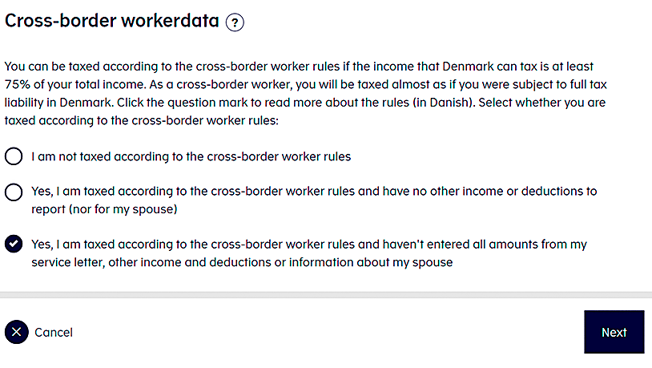
When you change your tax assessment notice in TastSelv, you may be asked whether you want to be taxed under the cross-border rule. If you meet the requirements, you will see three options:
Option 1: Choose this if you do not want to be taxed under the cross-border rule.
Option 2: Choose this if you want to be taxed under the cross-border rule and have no additional income or deductions to report for yourself or your spouse.
Option 3: Choose this if you want to be taxed under the cross-border rule and need to report additional information, such as income, deductions or information about your spouse.
Working from home and tax
If you live in Sweden and work in Denmark, working from home in Sweden may affect where your salary is taxed.
If you have many working days in Sweden, part of your salary may be taxed in Sweden instead of Denmark. The rules depend on whether you meet the conditions of the Öresund Agreement.
See our page about working from home and taxation
Keep track of your remote working days
Skattestyrelsen provides a tool that can help you keep track of your working days in Denmark and your remote working days in Sweden. This can help you determine whether you meet the conditions of the Öresund Agreement and prepare your Danish tax return and tax assessment notice.
The current tool is available in Danish only.
Get an overview of your working days at skat.dk
Change your tax assessment notice in TastSelv
From mid-March each year, you can view and change your Danish tax assessment notice, årsopgørelse, in Skattestyrelsen's online self-service system, TastSelv.
You can log in with MitID or a TastSelv code issued by Skattestyrelsen. When you submit your changes in TastSelv, you can see the result immediately.
If you cannot use TastSelv, you must submit your information on paper. In April, the tax assessment notice is sent by post to people who are exempt from using TastSelv or are not registered for Digital Post.
Read about the tax assessment notice at skat.dk
Submit your tax return on paper
If you need to submit your tax return on paper, you can order it through TastSelv or use form 04.009 at skat.dk.
Find form 04.009 for taxpayers with limited liability at skat.dk
If you are taxed under the cross-border rule, you also need to complete supplement form 04.031. The form also indicates whether you need to use any additional forms.
You only need to submit further documentation if Skattestyrelsen asks you to.
Find form 04.031 for taxation under the cross-border rule at skat.dk
Good to know: You do not need to submit a paper tax return if you report your information in TastSelv.
Enter amounts in Danish kroner
All amounts in your Danish tax assessment notice must be entered in Danish kroner (DKK).
If you need to convert amounts from Swedish kronor (SEK), you can find current exchange rates at the Danish central bank, Danmarks Nationalbank.
See current exchange rates at Danmarks Nationalbank
Important dates for your tax assessment notice
- 24 March: Skattestyrelsen opens the digital tax assessment notice
- 1 May: Deadline for making changes to your digital tax assessment notice
- 2 July: Deadline for submitting your tax return on paper
Important boxes in your Danish tax assessment notice
The boxes you need to check or fill in depend on your tax situation and whether you choose to be taxed under the cross-border rule.
Below, you can find guidance on the boxes that are particularly relevant if you live in Sweden and work in Denmark.

Box 11 shows your total gross salary before labour market contributions, AM-bidrag, and income tax, A-skat.
In TastSelv, you can see the total income your employer has reported to Skattestyrelsen. You can also find your total annual income on your final payslip for the year.
Box 11 is locked, so you cannot change the amount yourself. If the amount is incorrect, you should first contact your employer. If the amount needs to be adjusted because some of your salary should be taxed in Sweden, for example due to remote work, you must contact Skattestyrelsen.
If you are a member of a Danish trade union, you can deduct your membership fees.
The amount is usually already entered in TastSelv. If the amount is incorrect, contact your trade union first. If necessary, you can then contact Skattestyrelsen.
You can claim a travel deduction, befordringsfradrag, for travel between your home and your workplace in Denmark.
The deduction is based on the distance travelled and the number of days you actually travel to and from work. You may also be entitled to an additional deduction for crossing Öresund by bridge or ferry.
Kilometre deduction
You can claim the deduction regardless of whether you travel by car, train or other means of transport. You only get a deduction if your total journey to and from work exceeds 24 km per day. This means that the distance between your home and workplace must be more than 12 km each way.
Only include days when you actually travel to your workplace. Holidays, sick days and days when you work from home do not count.
Travelling by ferry
If you travel by ferry between Helsingborg and Helsingör, only count the distance travelled on land when calculating your kilometre deduction. The ferry crossing itself does not count towards the 24 km minimum distance.
You may deduct your ferry expenses if your total journey on land to and from work exceeds 24 km per day.
Travelling by train or car across the Öresund Bridge
If you travel across the Öresund Bridge, you may be entitled to an additional deduction for each crossing. Different rates apply depending on whether you travel by car or public transport.
You can only claim the deduction if you pay your own travel expenses.
Current transport deduction rates
Travel deduction rates and the additional deductions for crossing Öresund may change from year to year.
See transport deduction rates and rules at skat.dk
Calculate your transport deduction
To calculate your deduction, you need your home address, your workplace address and the number of days you actually travelled to work.
In TastSelv, use the calculator next to box 51 to enter your actual transport deduction.
Skattestyrelsen may ask you to document your working days. It is therefore a good idea to keep relevant documentation, such as receipts for commuter passes or records from Öresundsbron.
If you are a member of a Danish unemployment insurance fund, a-kasse, you can deduct your membership fees.
The amount is usually already entered and cannot be changed in TastSelv. If the amount is incorrect, contact your unemployment insurance fund first. If necessary, you can then contact Skattestyrelsen.
If you are taxed under the cross-border rule, you automatically receive a full year's personal allowance.
If you are not taxed under the cross-border rule and have only been taxable in Denmark for part of the year, you can choose to receive a personal allowance combined with a full-year conversion of your income. To choose this option, tick box 69 in your tax assessment notice.
If you do not choose the personal allowance and full-year conversion, you will be taxed based on your actual income for the period without a personal allowance.
Other boxes when using the cross-border rule
If you choose to be taxed under the cross-border rule, the following boxes may also be relevant:
- Box 21: Contributions to Danish private pension schemes
- Box 43: Interest payments on Danish student loans
- Box 56: Spousal maintenance and child support payments
- Box 348: Interest payments on public debt
- Box 460: Service deduction and craftsman deduction
- Box 462: Interest payments relating to property in Sweden
- Box 463: Danish interest payments on consumer loans
- Box 464: Foreign private net interest payments, such as interest on Swedish student loans
- Box 465: Contributions to early retirement and flex allowance schemes
Only complete boxes 470–478 with information about your spouse if you are married, live with your spouse and want to request an extra personal allowance because your spouse has no or a low income. If your spouse works and has an income, you do not need to complete these boxes.
Find form 04.031 for taxation under the cross-border rule at skat.dk
After you have submitted your information
Once you have checked and entered all relevant information in TastSelv, select Accept to submit your changes.
Remember that if you live in Sweden, you must also file a Swedish income tax return and report your Danish income.
Did you find this information relevant?
Do you want to elaborate?
We can help you
You are always welcome to visit our Information Center in Malmö to get help with your questions regarding working, moving or studying in Denmark.